Websites
What Should a Real Estate Agency Website Actually Do?
Why an agency website should do more than display listings — including enquiry capture, SEO basics, branding, and a connected path into your CRM workflow.
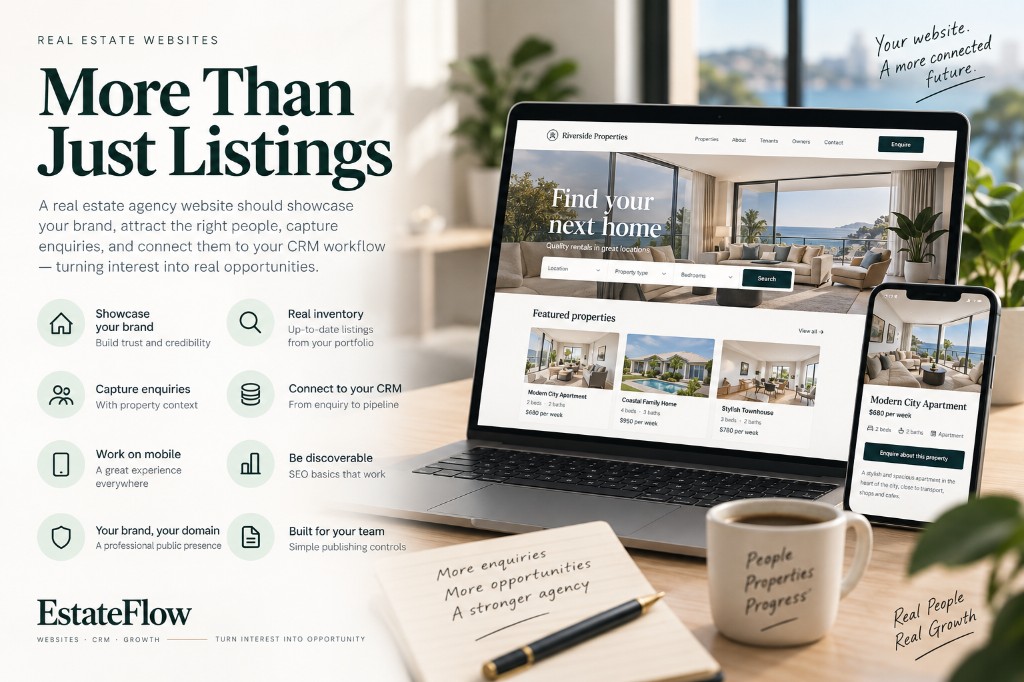
1A website is not a brochure with a domain
Many real estate agency websites are built like digital print ads: logo, hero photo, a few featured listings, a phone number, and a contact form that emails someone who is already overloaded.
That can look polished. It rarely operates well.
A modern real estate agency website should do a harder job. It should present your brand and inventory publicly and feed demand into the same operational system your team uses to follow up, qualify, and convert.
If your site only “looks good,” you still have a marketing asset. If your site connects listings, enquiries, and CRM workflow, you have a growth channel.
2What a real estate agency website should actually do
Establish a professional agency presence
Prospects and owners judge credibility in seconds. Clear positioning, consistent branding, trustworthy photography, and readable contact paths matter.
Presence is necessary. It is not sufficient.
Publish property listings from real inventory
Listings should reflect the portfolio your team manages — not a separate marketing database that drifts out of date.
Useful listing pages typically include:
- Property and unit details your prospects care about
- Media that matches what is actually available
- Status that does not contradict operations
- A clear next step (enquire, request a stay, contact the agency)
When marketing inventory and operational inventory diverge, your website becomes a source of awkward conversations: “That unit was rented last week.”
EstateFlow’s website model is built to publish from the same portfolio context the agency already works in. See the Websites guide and Properties guide.
Help people search and discover
Visitors should be able to find relevant homes without calling you first.
That usually means:
- Browse and filter experiences appropriate to your inventory
- Property detail pages that answer basic questions
- Mobile layouts that do not punish thumbs
Discovery is not vanity UX. It is how serious prospects self-qualify before they enquire.
Capture enquiries with context
A contact form that only says “Name, email, message” creates weak leads.
Stronger enquiry capture includes:
- Which listing or page they came from
- Structured fields your team actually uses (move-in timing, budget range, stay dates when relevant)
- Enough message space for intent without forcing a novel
The outcome should not be “an email arrived.” The outcome should be “a lead exists with property context.”
Connect enquiries to lead management
This is the line between brochure sites and operating websites.
Brochure path
Website → inbox
Someone might reply. Someone might not. Context often lives in the email thread alone.
Connected path
Website → enquiry → lead → pipeline → follow-up → communication → conversion
The enquiry becomes a lead, ownership is clear, follow-up is scheduled, and conversations stay attached to the record when messaging is connected.
That connected path is the philosophy behind EstateFlow’s agency websites and CRM workspace. The public site is the front door; the workspace is where the work continues. Explore the operational side in the Leads guide.
Support booking or stay requests where applicable
Not every agency runs short stays. When you do, the website should collect request details that ops can act on — dates, unit interest, guest notes — instead of forcing a back-and-forth that starts from zero.
Request-based stays still need human confirmation in many businesses. The website’s job is to gather a complete request, not to promise automatic confirmed bookings your operations cannot support.
Carry branding and custom domains professionally
Owners and prospects notice mismatched domains, generic templates with no agency identity, and “powered by” clutter that overshadows your brand.
A serious agency site should support your brand presentation and a custom domain so the public experience feels like your company — while still connecting to your workspace behind the scenes.
Work on mobile
A large share of listing traffic arrives on phones. If enquiry forms are painful on mobile, you are filtering out demand for no strategic reason.
Test the real path: find a listing → read details → submit an enquiry with one thumb.
Support basic SEO without gimmicks
You do not need growth-hacking folklore. You do need:
- Clear page titles and descriptions
- Readable URLs
- Indexable listing and content pages
- Fast enough performance for real devices
- Legal and trust pages that searchers and partners expect
SEO for agencies is mostly clarity and consistency: help people find the right property pages and understand who you are.
Include the legal and trust pages people look for
Privacy policy, terms, and clear contact identity are not busywork. They reduce friction for cautious prospects and set expectations for how you handle enquiries.
Give your team a publishing workflow
Marketing should not require a developer for every copy tweak — and ops should not publish stale listings by accident.
A workable publishing workflow usually includes:
- Draft vs. published states
- Preview before going live
- Clear ownership of what is public
- Updates that flow from portfolio changes when listings are connected
3Website features that matter more than decoration
When you evaluate a real estate website platform, prioritize:
| Capability | Why it matters |
|---|---|
| Listings tied to portfolio data | Prevents marketing/ops drift |
| Enquiry → lead creation | Starts follow-up immediately |
| Property context on the lead | Better first conversations |
| Branding + custom domain | Credible public identity |
| Mobile enquiry UX | Protects conversion |
| SEO basics | Helps discovery without spam |
| Publishing controls | Safer updates |
| Connection to CRM/workspace | Turns traffic into pipeline |
Animations and novelty layouts can wait. Broken enquiry handoff cannot.
4Common failure modes
Pretty site, dead inbox. Forms email a shared address nobody triages.
Duplicate inventory. Website CMS and property software diverge within a month.
No ownership after submit. Leads arrive as anonymous tasks in someone’s head.
Desktop-only design. Listing browsers bounce before they enquire.
SEO as keyword stuffing. Pages read like spam and still do not rank for local intent.
Website treated as a separate product forever. Marketing, CRM, and operations never share context.
5What “good” looks like in practice
Imagine a prospect on their phone at lunch:
- They find your agency site on a custom domain.
- They filter to 2-bedroom units in a neighborhood you actually manage.
- They open a listing with current details and photos.
- They submit an enquiry asking about availability next month.
- Your team sees a lead with that property context.
- A follow-up is already waiting for first response.
- The conversation continues with history attached.
That is a website doing its job.
6Final takeaway
A real estate agency website should not merely display listings. It should represent your brand, help people discover inventory, capture enquiries with context, and hand that demand to a connected lead and operations workspace.
Brochure sites generate impressions. Connected sites generate follow-up.
If you are redesigning your agency website in 2026, judge every feature by one question: Does this help a serious enquiry become owned work in our pipeline? Everything else is secondary.