Leads & CRM
Real Estate Lead Management: A Practical Guide to Better Follow-Up
How real estate agencies can capture enquiries, assign ownership, build a clear pipeline, and follow up without losing demand in inboxes and spreadsheets.
1What real estate lead management actually means
Real estate lead management is the practice of capturing every serious enquiry, giving it context, assigning ownership, and moving it through follow-up until it converts, stalls, or closes out — without relying on memory or a shared inbox as the system of record.
It is not the same as collecting email addresses. It is not the same as having a CRM logo on your homepage. Lead management is the operational habit of making sure demand does not disappear between the website form and the next human conversation.
For agencies and property managers, leads usually look like:
- A website enquiry on a specific listing
- A general “looking for a 2-bedroom” form submission
- A referral that arrives by phone or text
- A returning prospect who asked about a different property last month
The channel changes. The need for ownership, context, and follow-up does not.
2Capture every enquiry
If leads arrive in five places — website forms, personal inboxes, Instagram DMs, phone notes, and a spreadsheet — your pipeline is already incomplete.
A practical standard:
- Website enquiries create a lead automatically
- The lead includes contact details and the property or interest context when available
- The team can add manual leads for phone and referral demand without inventing a parallel process
Capture is the foundation. Everything else fails if half of your demand never enters the system.
EstateFlow’s product documentation covers how website enquiries connect into lead workflows in the Leads guide and Websites guide.
3Give every lead context
A name and phone number are not enough to follow up well.
Useful context includes:
- Which property or unit they asked about
- What they said in the enquiry message
- Source (website form, manual entry, and so on)
- Timing — when they asked, and whether anyone has responded
- Tags or notes that help the next person pick up the thread
Without context, agents repeat questions the prospect already answered. With context, the first reply can sound informed: “Thanks for asking about 214 Maple — are you looking for a June move-in?”
4Create a clear pipeline
Lead management needs stages your team actually uses.
A simple agency pipeline might look like:
- New — just arrived, not yet worked
- Contacted — first outreach sent or call made
- Qualified — budget, timing, and interest are clear enough to progress
- Showing / tour — active viewing or next-step scheduling
- Negotiation / application — paperwork or offer in motion
- Converted — won outcome (lease, stay, sale process as applicable)
- Lost / closed — not proceeding, with a reason when possible
The exact labels matter less than shared meaning. If “Qualified” means different things to different agents, reporting becomes theater.
Keep the pipeline short enough that people update it. A fifteen-stage funnel that nobody maintains is worse than a five-stage one that is honest.
5Assign ownership
Unowned leads are delayed leads.
Assignment rules should answer:
- Who is responsible for the first response?
- What happens when that person is out?
- Can a lead be reassigned without losing history?
Ownership is not about politics. It is about response time. Prospects rarely complain that two people coordinated well; they notice when nobody replies for two days.
6Make follow-up part of the workflow
Most real estate demand is lost in the quiet days after first contact — not in the absence of a CRM login.
Follow-up should be:
- Scheduled with a due date
- Visible on a “today” or work queue view
- Closable when done, with a note about what happened
- Tied to the lead so the next person sees the history
Spreadsheet “Last contacted” columns fail because they do not remind anyone. Calendar reminders fail when they are personal and not shared. Lead follow-ups work when they are part of the same record as the enquiry.
7Keep communication attached to the lead
When email, SMS, or WhatsApp conversations are connected for your agency, those threads should live next to the lead — not only in a personal phone.
Even when a channel is not connected yet, logging outreach on the lead (“Called 3/12, left voicemail”) beats relying on memory.
The goal is a single place to answer: What did we last say, and what is next?
8Automate repetitive actions
Humans should qualify interest and negotiate. Software should handle the repetitive scaffolding:
- Notify the team when a new website enquiry arrives
- Create a follow-up for first response
- Assign a default owner based on your rules when that fits your process
- Nudge when a lead goes inactive
- React when status changes in ways that should trigger internal work
Automation is not a substitute for judgment. It is a way to stop dropping the ball on the same five steps every time.
See the Automations guide for how trigger-based workflows fit agency operations.
9Measure what happens to leads
You cannot improve what you cannot see.
Useful operational metrics (even informal ones):
- Time to first response
- Number of new leads waiting without an owner
- Follow-ups overdue today
- Conversion by source or property type
- Reasons leads are marked lost
Avoid vanity counts. “500 leads this month” means little if 400 never received a second touch.
10Common lead-management mistakes
Treating the inbox as the CRM. Email is a channel. It is not a pipeline.
No ownership. “Someone will get it” usually means nobody will.
Updating stages only when asked. If the board is wrong, coaching and forecasting are wrong.
Restarting context every handoff. Reassignment without history wastes prospect goodwill.
Automating replies without a human plan. Fast auto-acknowledgements help; automated promises you cannot keep do not.
Tracking activity instead of next actions. Notes about the past matter less than a clear next step.
11Building a better lead workflow
A practical upgrade path for most agencies:
- Centralize capture — website forms and manual entries land in one lead list.
- Require ownership — every new lead gets a responsible person.
- Standardize stages — agree on a short pipeline and use it.
- Schedule follow-ups — make the next touch a dated item, not a hope.
- Attach communication — keep outreach and replies with the lead when channels are connected.
- Automate the scaffolding — notifications, first follow-ups, inactive nudges.
- Review weekly — look at overdue follow-ups and stuck stages, not just new volume.
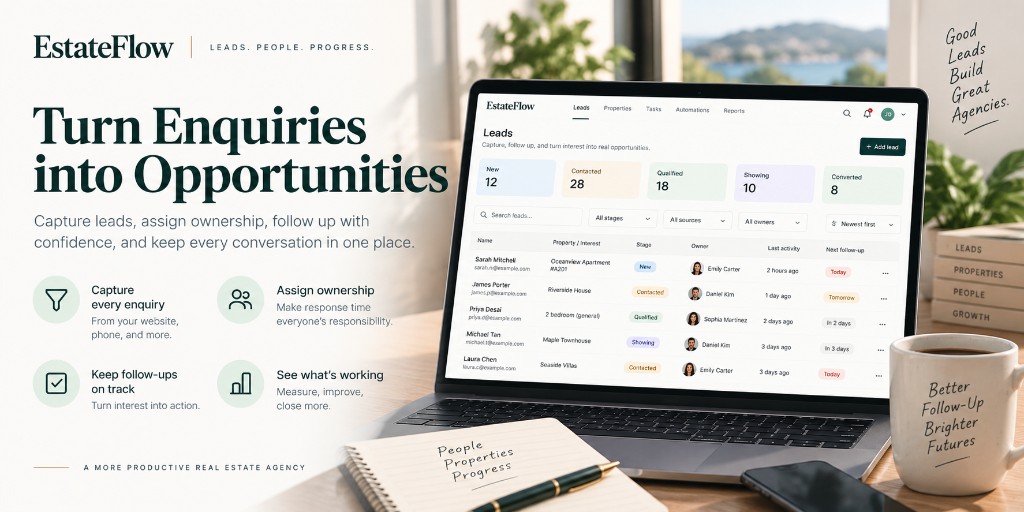
EstateFlow is designed as a connected CRM and workspace for this kind of flow: enquiry → lead → pipeline → follow-up → communication → conversion, with property context when the prospect asked about a specific listing. The point is not to add another place to type notes. It is to keep demand visible until the outcome is clear.
Better follow-up is rarely a motivational problem. It is a systems problem. Fix the system, and the team’s effort starts compounding instead of leaking.